

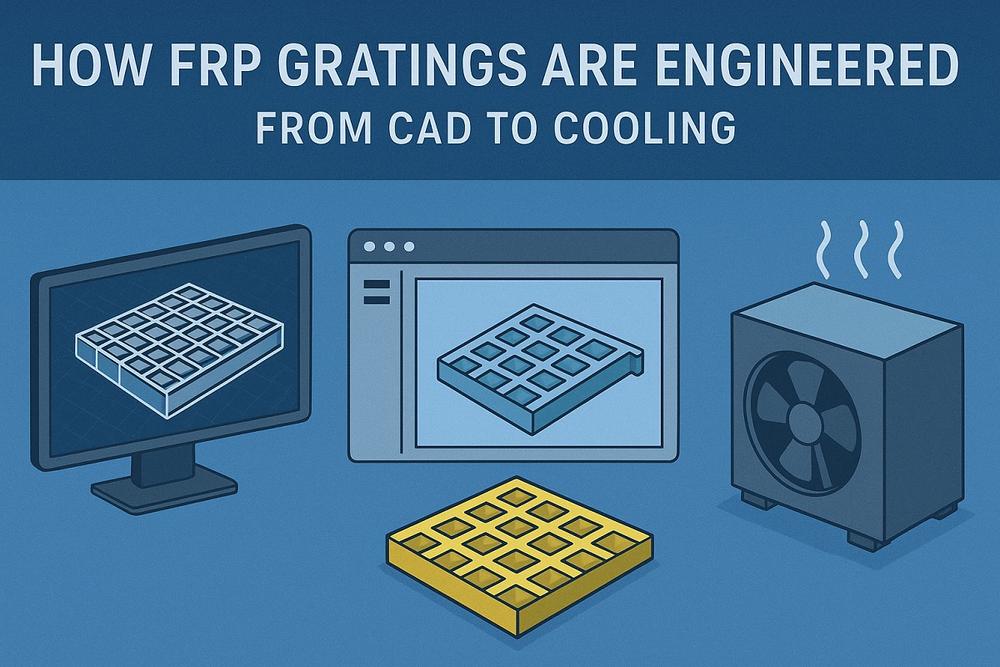
The production of industrial walkways, catwalks, and large-span floor systems more and more depends on advanced composite materials that promise durability, corrosion resistance, and light strength. Of these, one product has risen to prominence for requiring span-capability and low maintenance: FRP Pultruded Gratings. Starting from digital design and culminating in post-cooling of the profiles, the pultrusion process converts raw fibre, resin, and heat into structural panels designed for long-span support in hostile environments.
This journey takes through each key stage of the process—from CAD specification to fibre reinforcement, impregnation, die forming, pull-mechanism and trimming, and cooling to final assembly—offering detailed understanding beyond usual summaries.
Digital Design and CAD Specification
All major-span uses start in the digital world. Engineers utilize CAD (computer-aided design) software to model the geometry of the grating panel, bearing-bar profiles (tend to be I- or T-shaped), cross-rod arrangement, support conditions and expected loads. Material numbers—such as glass content by weight, resin system choice (polyester, vinyl ester, or epoxy), and expected span lengths—are established at this point.
For instance, in designing FRP Pultruded Gratings for a chemical-processing walkway, the CAD model needs to consider heavy duty loads, chemical exposure, and big span (e.g., 5 m or bigger) between supports. The CAD output produces tooling drawings, prescribes die cavity geometry and provides input to production line setup.
Since pultrusion is a constant-cross-section process, the CAD has to include any allowance for shrinkage, die expansion or contraction, and resin cure effects. The accuracy here determines how close the final shape will be to design tolerances, particularly where long spans require a small deflection and accurate alignment.
Fibre Reinforcement Preparation
After the CAD design is finalized, the actual materials are prepared. Continuous glass fibres—usually rovings (groups of continuous filaments) for longitudinal strength and glass mat or woven fabrics for transverse reinforcement—are prepared. The fibre creels are set up to supply the precise amount and orientation required in the CAD material schedule.
For FRP Pultruded Gratings of high-span, an increased glass-to-resin ratio is typical, since the unbroken glass rovings produce enhanced tension-, compression- and bending-strength along the bearing bars, while the mat layers contribute impact and transverse strength. The layers of reinforcement are programmed into preformers or guide systems that mold them to the initial bearing bar cross-section. This is an important stage: mis-oriented fibres or varying feed speeds will undermine the consistency of the end profile.
Resin Bath and Impregnation
The glass reinforcement having been placed, the process now proceeds to resin impregnation. The fibres are conveyed through a resin bath (or injection chamber) where the chosen thermosetting resin system (usually isophthalic polyester or vinyl ester for corrosion protection) is mixed with pigments, fillers, catalysts and other additives. The resin “wets-outs” the fibres, covering every filament and occupying voids.
The resin-to-glass proportion, viscosity of the resin blend, and bath dwell-time are all precisely controlled variables. In the case of FRP Pultruded Gratings, an increase in the glass proportion results in greater load-carrying ability and longer spans; producers consistently state that pultruded-grating bars outperform similar molded-grating panels for long-span applications due to this unbroken glass content. After impregnation, a surface veil (a thin fabric cover) can be applied to enhance surface finish and chemical/UV resistance.
Die Forming and Curing
Then the wet-out composite is drawn into a hot steel die of the bearing-bar profile as specified in CAD. In the die, composite is formed, pressed, and cured. Polymerisation of the resin is initiated by heat, converting the impregnated fibres into a stiff structural profile. Since the process continues indefinitely, the composite moves at a predetermined speed in harmony with the pull system. For big-span FRP Pultruded Gratings, the bearing bars typically take I- or T-shapes, with the cross-rods subsequently inserted to provide stability to the mesh pattern.
The internal temperature of the die, fibre tension, pull rate, and cure time all determine the end properties—too quick or under-cured and the resin can under-cure; too sluggish or over-heated and the part will distort or degrade. The difficulty with long-span gratings is keeping the structures dimensionally stable and the bearing-bar straightness and cross-rod alignment free from degradation over long lengths.
Pull Mechanism and Cut-off
After being cured, the profiles come out of the die and are drawn in a continuous manner by a caterpillar or belt type mechanism. Pull speed is synchronized to curing kinetics to ensure uniform cross‐section and prevent high internal stresses. Once released from the puller, the profile goes through a cut-off saw and is trimmed to given lengths—usually CAD designed to module length for panels (e.g., 3 m, 4 m, or special long panels to 20 m for specific applications).
When we’re talking about big span floor systems that use FRP Pultruded Gratings, you can actually make the panels as long as possible so that you don’t have to deal with as many joints. This helps keep the whole thing flowing smoothly and makes it easier to take care of in the long run.
Cooling and Stabilization
Following cutting, the profiles generally move into a cooling or post-cure area. Quenching can set internal stresses, whereas slow cooling potentially permits distortion. For wide span systems, bar straightness and dimensional tolerance are vital—any warp or bend shortens effective span length or raises deflection.
Most producers store the cut profiles on rollers or hangers to relieve residual stresses and preserve geometry before assembling. Along with this, there is inspection and conditioning: straightness is measured on bars, glass/resin ratio can be inspected through sample, and surface imperfections are stripped. Through this final stage the profiles come ready for grating assembly.
Panel Assembly and Quality Control
For the final grating panels, bearing bars are aligned parallel to each other, and cross-rods are fitted perpendicular through pre-drilled bar holes—a mechanical lock with adhesive or epoxy to join them. Grid spacing, bar spacing (which is used to calculate open-area ratio), and edge framing are calculated from the CAD plan for long-span deployment.
For example, a wide platform with 10 m span can choose 1.5″ I-bar with cross-rod spacing at 19 mm to achieve maximum stiffness. After being assembled, panels are visually inspected, load tested (especially for high-span systems) and certified (such as flame spread rating or chemical compatibility). The higher content of glass and even profile of FRP Pultruded Gratings provide consistent long-span performance and greater stiffness per weight than most traditional materials.
Installation Planning for Long-Span Installations
When installed in large-span applications—chemical-plant catwalks, offshore platforms, or wastewater treatment bridges—the planning initiated in CAD proves worthwhile. With the pultruded panels lighter than steel and corrosion-proof, they are easier to handle and anchoring less stressful. Installers have to use appropriate support spacing as stipulated in the engineering data; conventional steel equivalents may permit spacings close together, but high-span pultruded gratings can still accommodate spans of 3 m–8 m based on section size and load.
An. nors, clips, and fasteners are used to eliminate vibration and lateral movement; installation details tend to focus on on-site trimming with conventional tools (no welding) and on making sure that. panels support the entire span without interruption or sag. Maintenance. is minimal—no. paint, no corrosion surfaces—but checking. over time for deflection is advisable for long-span systems.
Why This Process Matters for Long Spans
Historical grating materials (like steel bar grating) are prone to corrosion, excessive weight, and high maintenance–particularly in chemically-aggressive or out-of-doors conditions. The above pultrusion process produces FRP Pultruded Gratings with high glass-content bearing bars, identical cross-sections, chemical and corrosion resistance, low weight, and high stiffness per unit mass. Since the profile is drawn as opposed to cast, dimensional stability is high and long spans may be realized with reduced deflection and less support.
The relative benefit is evident when choosing walkways or platforms with minimal support subframe or in retrofit applications where weight-savings are beneficial. In brief: the process delineated here—CAD through cooling and assembly—provides a strategic material benefit for long-span grating applications.
Final Remarks — Performance and Life Cycle Advantages
Pultruded systems provide decades of service with little maintenance when properly engineered and installed. In long-span applications, fewer joints translate to fewer points of weakness, and the consistency from the pultrusion process ensures the structure’s performance is sustained over long spans. Choosing the proper resin system (chemical or fire resistant), appropriate bearing-bar geometry (load and span), and adequate cooling and installation are all critical to the realization of the advertised performance of FRP Pultruded Gratings.
It is the combination of computer-aided design, precise material feed, impregnation, die forming, cooling, and assembly that separates high-quality systems from generic products. For industrial, infrastructure or marine applications on a large scale requiring long-span, robust, low-maintenance platforms, the pultrusion path makes sense for a reason.
Buyers-in should ask for comprehensive producer documentation: span tables, deflection information, glass-to-resin ratio, long-term creep behavior, chemical-resistance certification and field case histories. Only when aware of the end-to-end production process can stakeholders best determine if the FRP Pultruded Gratings supplied will meet requirements throughout the life of the installation.
Conclusion
Through following the systematic process—from CAD geometry definition to fibre reinforcement, resin bath, heat-formed die, pull mechanism and precision cutting, quench and stabilisation, to final assembly—manufacturers produce high-quality panels with confidence that can cover great distances. In harsh industrial conditions, the process supports the robustness and durability of the finished product, and provides concrete benefits compared to traditional materials both in performance and lifecycle cost.
✅ FAQs about CAD to Cooling
What is the pultrusion process in FRP grating manufacturing?
Pultrusion is a continuous manufacturing process that pulls fibers through a resin bath and heated die to create strong, uniform FRP gratings with consistent quality.
How does CAD design help in FRP grating production?
CAD modeling allows precise design customization, ensuring that FRP gratings meet exact load-bearing, dimensional, and environmental specifications before production begins.
Why is the cooling stage important in pultrusion?
The cooling stage stabilizes the resin matrix and solidifies the final structure, giving FRP gratings their rigidity, strength, and dimensional accuracy.
What are the advantages of long-span FRP gratings?
Long-span FRP gratings offer superior strength-to-weight ratio, corrosion resistance, and low maintenance, making them ideal for heavy-duty industrial applications.
Where are FRP gratings commonly used?
FRP gratings are used in industrial flooring, chemical plants, offshore platforms, wastewater treatment plants, and marine applications for their durability and safety.
Feel free to contact IT Company Ahmedabad for Web Design, Business Branding Services and SEO Services in Ahmedabad.
Also Read:
