



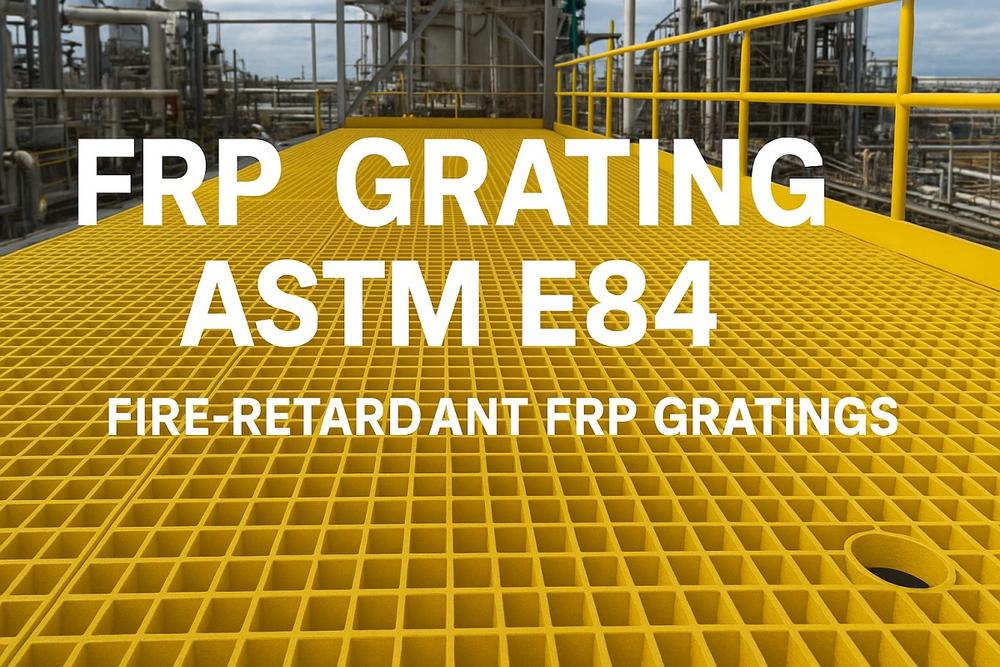
Fire performance in industrial flooring, walkways and platforms of chemical plants, offshore platforms, power-plants and heavy structures is now as important as corrosion resistance and mechanical strength. A major flame-spread measure in the United States is the ASTM E84 “Tunnel” or “Surface Burning Characteristics of Building Materials” test.
Indian composite grating manufacturers are increasingly getting their processes aligned to ensure FRP pultruded gratings India satisfy or come close to ASTM E84 fire‐retardancy standards. This article examines how this is really done—beyond catch‐all descriptions—into material formulation, pultrusion technology, resin systems, test protocols, factory practices and project‐level selection criteria.
Knowing ASTM E84 and Why It Is Important
Before diving into Indian production practices, it’s important to grasp what ASTM E84 measures and why it applies to gratings.
The test places a 25 mm thick specimen in a horizontal tunnel, applies a controlled flame, and measures flame spread index (FSI) and smoke‐density index (SDI). An FSI of 25 or less typically corresponds to “Class 1” and is broadly accepted in many industrial and institutional settings. Indian manufacturers typically reference selective resin classifications (e.g., “Class 1, 25 or less”) corresponding to ASTM E84 performance.
Why bring this into grating production? Most applications—walkway panels over chemical pits or on offshore platforms—are subject to fire code or global asset‐owner requirements calling out ASTM E84 or similar (e.g., BS 476). With poor fire performance, the composite panel can continue to serve as a flame path or produce objectionable smoke density in emergency egress situations.
Resin Systems and Formulation Options
One of the prime levers in attaining fire-retardancy is in the resin and additive package employed in panel manufacture. FRP pultruded gratings India suppliers consistently supply resin grades termed “FR” or “fire retardant”, frequently with respect to isophthalic polyester (IFR), vinyl ester (V-FR) or phenolic types. For instance, one company’s molded system refers to a fire‐retardant isophthalic polyester resin to achieve “Class 1, 25 or less” flame spread.
In pultruded form, continuous glass-fibre rovings are carried through a bath of resin, and the resin selection is essential right from the beginning. With a resin with fire-retardant additives (e.g., halogen-free or low‐smoke phenolic), the cured profile will achieve or is intended to achieve low FSI values. Some Indian manufacturers mention the fact that they can convert to phenolic matrix for an FSI of close to 5 or less (“Class 1, 5 or less”). Such a performance is extremely important for high-risk petrochemical or offshore environments.
Aside from resin type, package additive issues: mineral fillers (e.g., aluminium trihydrate, magnesium hydroxide), intumescent coatings, or synergistic halogen‐free flame-retardants are increasingly being utilized. They lower peak heat release, impede flame spread along the composite, and lower smoke evolution. In short: FRP pultruded gratings India manufacturers in the domestic scene are not just applying generic isophthalic resin—they are engineering higher‐grade resin systems aimed at FSI/SDI targets.
Manufacturing Process: Pultrusion + Precision
Pultrusion is intrinsically conducive to fire-retardant manufacturing if well-managed. In India, FRP pultruded gratings India companies emphasize the following process features favoring ASTM E84 compliance:
- Continuous reinforcement of fibres (rovings and mats) drawn through a heat die guarantees consistent resin wet-out, minimizing voids that may favour flame spread.
- Employment of heat die and cured management guarantees the composite achieves complete cross-link density; less-than-complete cure may compromise fire performance.
- Post-cure or thermal conditioning can be used to further expel volatiles that would otherwise enhance smoke production.
- Resin mix quality control (including level of flame-retardant filler) and fibre content means that the panel’s fire performance specification is maintained panel to panel.
- The panel assembly (cross-rods and bearing bars) is so constructed as to keep structural integrity without sacrificing the fire barrier: e.g., tightly fitted profiles reduce gap creation that might serve as flame path.
Therefore, the production practice of such companies offering FRP pultruded gratings India is not only corrosion/strength-oriented, but rather fire performance-oriented.
Fire Performance Testing and Certification
Fire-retardant claims need to be tested, and Indian manufacturers can increasingly either conduct in-house testing or outsource to accredited laboratories. For instance, in certain resin‐grade specifications, ratings of flame spread comparable to ASTM E84 (Class 1, ≤ 25; or even ≤ 5) are specified. Although some reports are universal, better producers provide test certificates for “ASTM E84 Class 1, 25 or less” or mention “low smoke” types.
When ordering FRP pultruded gratings India, asset owners ought to make the suppliers provide evidence that the panels or long profiles have been tested with the actual fibre/resin/filler mix under a named manufacturing process instead of accepting generic “FR grade” terminology. It can decline with fire performance if resin formulation is altered, if the fibre content decreases, or the curing is modified, so certification has to certify the exact material applied.
It is also advisable to ensure the smoke density index (SDI) is suitable for the evacuation plan of the project; certain uses demand an SDI < 450 or <300 depending on the code. Certain Indian manufacturers specifically intend to “low smoke” grade (e.g., phenolic matrix) to fulfill more stringent offshore or data-centre specifications.
Project-Level Specification and Selection Criteria
When FRP pultruded gratings India are specified by engineers for industrial applications, fire performance is among several considerations but frequently dictates resin grade and price. Companies have to trade-off between:
- Cost of resin (fire-retardant types are more expensive)
- Fibre content (higher percentage fibre gives higher strength but will increase flame spread slightly if filler not optimized)
- Surface finish (gritted or smooth) which can influence smoke generation
- Environment (enclosed areas, walk-in compartments versus open air) which affects tolerance to risk
Best-practice specification reports have the following requirements: “gratings produced using fire-retardant resin system tested in accordance with ASTM E84 with FSI ≤ 25 (Class 1) and SDI ≤ 450 [or project specific] when properly installed according to manufacturer’s instructions”. Subsequently, the procurement department asks for a certificate of test, batch‐traceable resin purchase records, and a manufacturing QA log.
Such a level of diligence provides assurance that FRP pultruded gratings India purchases are supported not only by commercial advertising but by third-party-verified fire‐performance credentials, in line with safety compliance standards (e.g., NFPA 101 for egress, offshore platforms, chemical plants).
Major Challenges and Indian Industry Solutions
Even though numerous Indian producers have fortified their products, ASTM E84‐level fire performance still poses technical and business challenges:
- Consistency: Consistent <25 FSI on a repeat basis involves careful control of resin chemistry and filler loading. Indian manufacturing lines will need to standardize resin blends and QC operations so that there are no differences.
- Smoke density: Flame spread can be managed, but smoke‐production is still a problem for controlled environments. Indian suppliers now provide “low smoke” phenolic systems to counteract this.
- Integration with structural design: Gratings are integral to the composite deck system. Where support members or fastenings are combustible, the fire hazard persists. Indian suppliers are collaborating with customers to provide complete assemblies.
- Cost versus performance: Fire-grade resin systems are more expensive. Indian purchasers considering FRP pultruded gratings India need to weigh initial cost against long-term safety record, particularly in high-hazard industries.
- Third-party testing: Some producers report internal test results; asset owners increasingly expect third-party accredited lab certificates on a few-yearly renewal basis.
However, industry reactions are encouraging: vinyl ester fire-retardant grades adoption, phenolic low-smoke systems introduction, batch testing to ASTM E84 equivalents, and inclusion of QA/QC data in factory traceability programmes.
Case Example: Industrial Chemical Plant Walkway
In a new large chemical complex in India, the client ordered walkways with FRP pultruded gratings India from an isophthalic fire retardant resin system rated “Class 1, 25 or less flame spread” in the manufacturer’s datasheet. Panels were provided with complete batch traceable resin spec, standalone lab certificate declaring FSI = 22, SDI = 380.
Full edge re-treatment (fire-retardant gel re-sealing of exposed cut edges) and galvanic compatible fasteners were part of field installation. The project team documented much reduced maintenance cost compared to galvanised steel gratings and met the facility’s fire safety audit. This is an example of how compliance is maintained in actual Indian project conditions.
Summary: What to Specify When Specifying in India
When specifying FRP pultruded gratings India having fire-retardant performance to ASTM E84, utilize the following checklist:
- Specify resin grade clearly: “fire-retardant isophthalic polyester / vinyl ester / phenolic, tested to ASTM E84 FSI ≤ 25, SDI ≤ 450”.
- Obtain certificate from an accredited laboratory for actual material combination.
- Ensure manufacturing process is recorded: fibre content, resin mix, curing cycle, post-cure, QA logs.
- Verify that the system installed (including support and fasteners) is fire-compatible.
- In high-risk environments (offshore, petrochemical, confined space) use low smoke phenolic systems or FSI ≤ 5 ratings.
- Check vendor’s record of consistent manufacturing and traceability of fire performance test batches.
- Calculate lifecycle cost: greater initial cost for fire‐grade resin can potentially mean reduced risk and lower insurance/maintenance expense.
Conclusion
FRP pultruded grating India manufacturers have come a long way in aligning their resin systems, manufacturing processes and test regimes with requirements of fire-performance standards like ASTM E84. By choosing the right resin, controlling pultrusion and curing and maintaining test documentation, they are now supplying composite gratings that meet Class 1 flame spread and industry expectations of fire safety.
For asset owners and engineers specifying walkways, platforms or trench covers in harsh environments, selecting and verifying fire rated FRP gratings is a must. With the passage of time, Indian manufacturers keep improving resin systems, reducing smoke development and developing installation compatibility—so that composite gratings are not only resistant to corrosion and durable but also safe in fire.
Feel free to contact IT Company Ahmedabad for Web Design, Business Branding Services and SEO Services in Ahmedabad.
Also Read: